


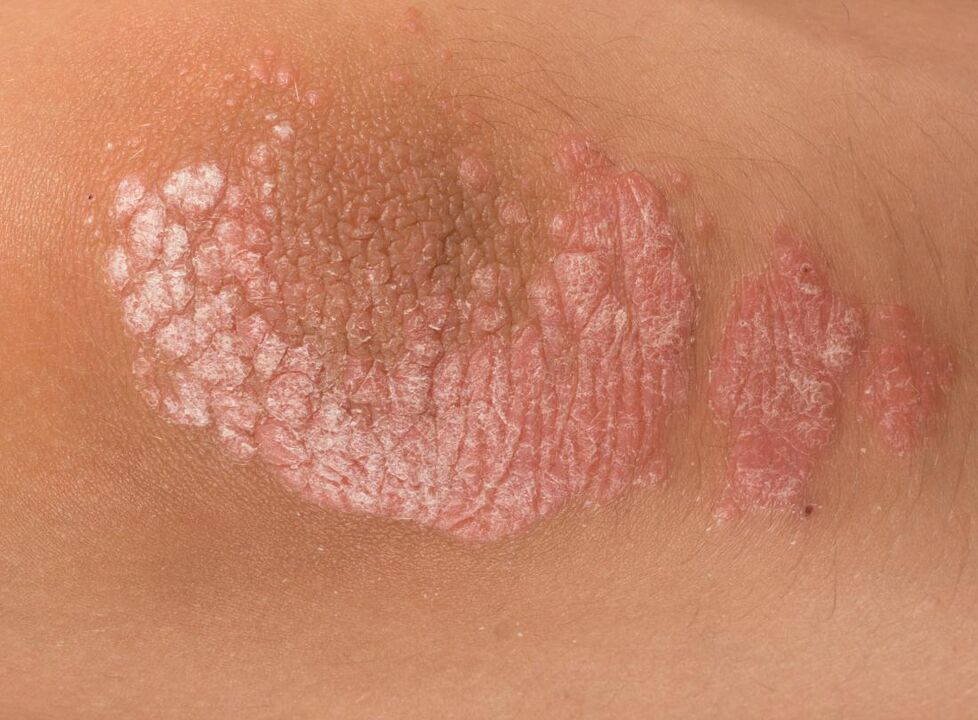
Psoriasis(squamosal lichen) is a non-infectious disease that manifests itself in the form of inflammation of the skin, usually chronic and recurrent.This is an erythematodesquamative pathology: on the skin on which silvery scales form, reddish, round, erythematous spots appear as a result of an abnormally high rate of skin cell growth, which in patients with psoriasis5-10 times higher(in practice, the skin dries and “flakes” faster than usual).The cause of the rapid cell growth is unknown, but it is believed to be related to a disorder of the immune system.Psoriasis often runs in families;Certain genes are related to the disease.
Lesions appear mainlyon the elbows, knees, scalp, lumbosacral region, arms and legs.They are often not bothersome, but may cause pain or itching.The course of the disease is unpredictable and can occur through exacerbations, improvements and sometimes even persistent remissions.In practice, in many cases, plaques “come and go”: in some periods they tend to get larger, sometimes they instead fade or disappear completely, and then return weeks or months later.
Psoriasis is a common disease that occurs inapproximately 1–5% of peopleall over the world.Light-skinned people are at higher risk of the disease, while people with dark skin color are less likely to develop the disease.The disease most often occurs in people agedfrom 16 to 22 years old and from 57 to 60 years old.However, people of all age groups and races are susceptible to psoriasis.
Symptoms of psoriasis
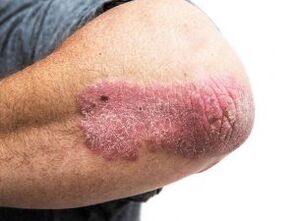
Plaque psoriasis(photo at right), the most common type of psoriasis, usually begins with the appearance of one or more small red, silvery, shiny patches (plaques) on the scalp, elbows, knees, back, or buttocks.The eyebrows, armpits, navel, skin around the anus and the sciatic groove may also be affected.Many people with psoriasis may have deformed, thickened, and pitted nails.
The first plaques may disappear after a few months or persist;Sometimes closely spaced plaques coalesce into large affected areas.Some people have no more than one or two small plaques, while other people have plaques that form large affected areas on the body.Thickened plaques or plaques on the palms of the hands, soles of the feet, or folds of skin on the genitals may cause itching or pain, but in many cases people do not experience symptoms.Although plaques do not cause much physical discomfort, they are very noticeable and often make a person feel self-conscious.The psychological stress caused by psoriasis can be very serious.
Psoriasis persists throughout life, but can come and go.Symptoms of psoriasis often improve in the summer when the skin is exposed to bright sunlight.For some people, years may pass between episodes of active disease.
About 5–30% of people with psoriasis develop arthritis (psoriatic arthritis).Psoriatic arthritis causes joint pain and swelling.
Exacerbations
Psoriasis can worsen for no apparent reason or as a result of various circumstances.Flare-ups are often the result of skin irritants, such as minor injuries and severe sunburn.Sometimes exacerbations occur after infections such as colds and streptococcal pharyngitis.
Exacerbations occur more often in winter, after drinking alcohol and as a result of stressful situations.Many medications, such as antimalarials, lithium, angiotensin-converting enzyme (ACE) inhibitors, alpha-interferon, and beta-blockers, may also cause psoriasis to worsen.
Exacerbations occur more often in people who are obese, people infected with the human immunodeficiency virus (HIV), or who smoke tobacco.
Rare types of psoriasis
Some less common types of psoriasis can have more serious consequences.
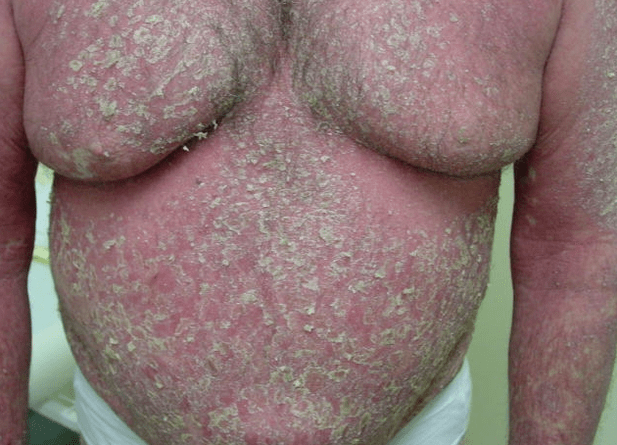
Psoriatic erythroderma(photo below) causes redness and peeling of all skin on the body.This form of psoriasis is serious because, like a burn, it prevents the skin from functioning as a protective barrier against injury and infection.
Pustular psoriasisis another rare form of the disease.In this form, large and small pus-filled blisters (pustules) form throughout the body.
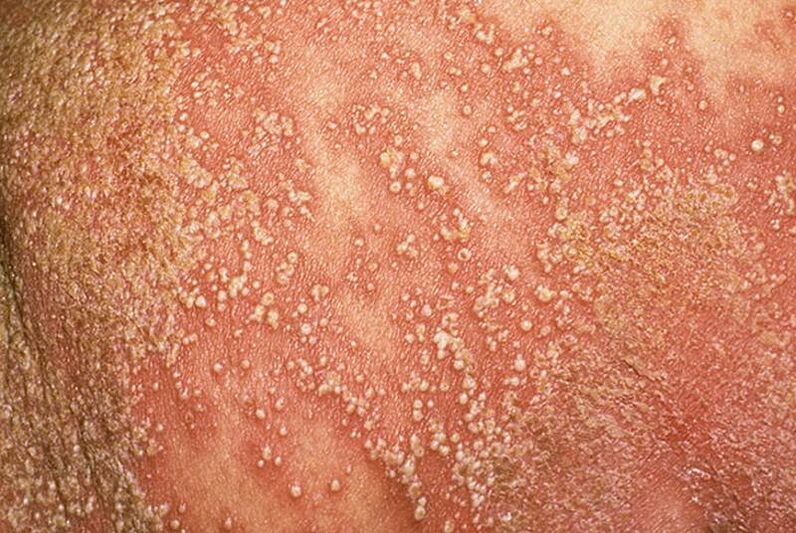
Palmoplantar psoriasisis a type of pustular form of the disease, in which pustules occur mainly on the hands and feet.It is sometimes called palms and soles psoriasis.
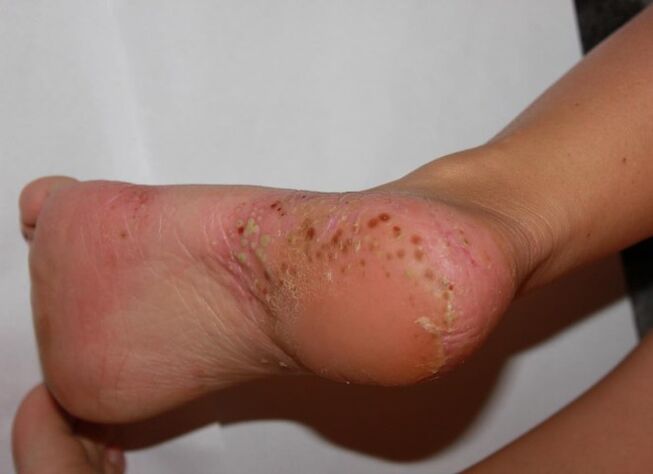
Causes of psoriasis
Age is not a factor, but the disease usually appears between the ages of 16-22 and 57-60 years.The severity and activity of psoriasis varies greatly, as with any other disease.Many people have spots on their scalp or elsewhere and are not bothered by it and lead normal lives.In others, the disease affects a large part of the skin, which brings significant discomfort to their lives.
What causes the disease?
The process begins in the human immune system and involves a type of white blood cell called a T cell.When a person has psoriasis, T cells are mistakenly brought into play and become overactive, leading to unhealthy and rapid growth of skin cells.
Scientists are still trying to figure out everything that happens inside the body of a psoriasis patient.
The disease is multifactorial.Classified as an immunologically mediated inflammatory disease.
Research conducted in this area has revealed that the main cause of the disease is the human immune system and genetics.Scientists also know that not everyone who inherits the disease genes gets psoriasis.It seems that a person must inherit the “right” combination of genes.The person must then experience an event (trigger) that causes the person to become ill.
Many people say that the disease appears after they have experienced one of the following triggers:
- severe emotional shock (stressful event);
- streptococcal tonsillitis and other infections;
- alcohol abuse;
- took certain medications, such as lithium, beta blockers, antimalarials, nonsteroidal anti-inflammatory drugs;
- spent a long time in cold, dry weather;
- cuts, scrapes or severe burns.
Most experts are not sure what causes the disease, but suspect specific contributing factors.According to assumptions, risk factors for the disease may be:
- autoimmunity (i.e., that it is an autoimmune disease);
- poor nutrition;
- leaky gut syndrome;
- an increase in the number of T cells in the blood, dermis and epidermis;
- difficulty digesting protein;
- emotional stress;
- hormonal changes;
- genetic predisposition;
- vitamin D deficiency;
- liver diseases.
Diagnostics
Doctors diagnose psoriasis based on the appearance of the scales and plaques and their location on the body.
Sometimes doctors take samples of skin tissue and examine them under a microscope to rule out other diseases (such as skin cancer).
Treatment of psoriasis
There are many medications available to treat psoriasis.Most often, a combination of medications is used, depending on the severity and extent of a person's symptoms.
Local preparations
The most commonly used drugs are topical (applied to the skin).Almost all people with psoriasis benefit frommoisturizersfor skin (emollients).
Other topical medications includecorticosteroids, often taken with a drug that is a form of vitamin D, or withtar.
Immunosuppressant medications are used to treat psoriasis that occurs in sensitive areas of the skin (such as the face, groin, or skin folds).
Severely thickened plaques can be made thinner with ointments containingsalicylic acid, which increase the effectiveness of other drugs.
Many of these drugs are skin irritants, and doctors must figure out which ones are best for which patients.
Phototherapy
Phototherapy (exposure to ultraviolet light) may also help clear up psoriasis for several months.Phototherapy is the use of ultraviolet light to treat skin diseases.
Phototherapy is often used in combination with various topical medications, especially if large areas of skin are affected.Traditionally, phototherapy has been performed in combination with the use of psoralens (drugs that make the skin more sensitive to ultraviolet radiation).This therapy is called PUFA.
Today, many doctors use narrowband ultraviolet B (NBUVB) treatment, which is equally effective as PUVA.However, UPUFV treatment is carried out without the use of psoralens and therefore does not have the same side effects, for example, does not cause extreme sensitivity to sunlight.
Doctors can also target individual plaques on the skin directly by using a laser that focuses ultraviolet light (excimer laser treatment).
Immunosuppressants
Immunosuppressants are medications used intentionally to weaken (suppress) the immune system to prevent psoriasis from getting worse.These medications can be taken by mouth or given by injection.Immunosuppressants can reduce the body's ability to fight infections.
Other drugs
Other medications may be used to treat severe forms of psoriasis and psoriatic arthritis.
- A synthetic aromatic analogue of retinoic acid is particularly effective in treating pustular psoriasis, but often increases levels of fats (lipids) in the blood and can cause liver and bone problems, as well as reversible hair loss.This medicine is taken by mouth.It can cause severe birth defects and should not be taken by women who may become pregnant.Women should wait at least 2 years after their last dose before trying to become pregnant.
- Biological drugsare produced from living organisms and inhibit certain chemicals involved in the functioning of the immune system.These medications are given by injection.They are generally the most effective drugs for severe psoriasis, but their long-term safety has not been studied.
Diet and natural skin emollients
For many people, natural emollients combined with a healing diet for psoriasis are one of the best ways to treat the disease naturally.
Research has examined the relationship between intestinal structure and the disease process for decades.Some experts believe that psoriasis is actually caused by intestinal permeability, especially in the area between the duodenum and jejunum.Consequently, the body strives to eliminate toxins through the skin.
Here are some natural remedies to help soften your skin and relieve itching:
- For mild forms of the disease, you can usetea tree oil and olive oil.These remedies will help relieve itching and soften hard plaques.A few drops (3-5) of tea tree oil should be diluted with a small amount of olive oil (half a tablespoon) and rubbed onto dry areas of the skin and directly into the areas of psoriasis 2-3 times a day.
- Aloe vera- Natural aloe vera gel is rich in anti-inflammatory and healing compounds.Gives a pleasant cooling sensation to itchy skin.If you suffer from the early stages of psoriasis, aloe can be very effective in relieving redness and irritation.Aloe vera gel can be found in most pharmacies and should be rubbed onto the affected area.
- Application of baths- to relieve itching and irritation, you need to take a bath with warm water, mix 3-5 teaspoons of olive oil with 2 glasses of milk.Add the resulting mixture to water.Oatmeal bathsThey will also help relieve itching.Take ground oatmeal (unflavored) and sprinkle it on top of your bath water.Epsom salt bath(magnesium sulfate) will help reduce itching and remove scales.You need to take 1-3 cups of magnesium-rich salts, a teaspoon of lavender essential oil and add it all to a bath of warm water.Take a bath for 30-40 minutes.
John Pegano Diet
Dr. John Pegano based his diet method on over 20 years of experience to develop a natural method for treating psoriasis.Patients who adhered to the strictly systematic recommendations of the Pegano diet felt all its benefits (symptoms of the disease decreased, long-term remission was observed).
| Diet rules | Foods to Avoid |
Patients with psoriasis are also advised to eat large amounts of cereals such as barley, oatmeal, buckwheat, oats, bran, corn, wheat, cornmeal, wild or brown rice and whole flax seeds. |
|
The above are just generally accepted recommendations aimed at ensuring that the disease goes into remission.In the fight against the disease, the patient must take all necessary measures so that the disease does not develop into a more serious form.If you decide to follow a diet, consult with your doctor to make recommendations based on your specific situation.
RememberPatients with psoriasis have varying symptoms, and each responds to medication, therapy, and diet differently.
Forecast
The forecast is unpredictable.This is a chronic disease that develops into outbreaks of varying intensity.The vast majority of patients have suffered from psoriasis for decades.Fortunately, this is often a mild form of the disease, with little damage to the skin and little impact on quality of life.
Conversely, a smaller percentage of patients suffer from severe psoriasis, which profoundly affects quality of life.This group of patients usually develops other diseases that affect the prognosis: arterial hypertension, diabetes mellitus, overweight, cardiovascular diseases, depression, etc.For this group of patients, however, various treatments have emerged in recent years that have radically changed the course of the disease.