


Timely detection of the disease is the key to successful treatment.This rule is especially typical for those diseases that are very difficult to treat.These include scaly lichen, better known as psoriasis.Over the past decades, this disease has spread to increasingly large areas, affecting infants and pensioners, tilting the statistics in a sad direction.
It is not for nothing that scaly lichen has aroused such serious interest.Today, from the classification of ordinary skin diseases, psoriasis has moved to systemic pathologies.It has been established that patients with this disease are more susceptible to infections, heart disease, depression, and diabetes.Given the lack of a unified treatment system, it is very important to identify psoriasis in the initial stages.
The first signs of psoriasis
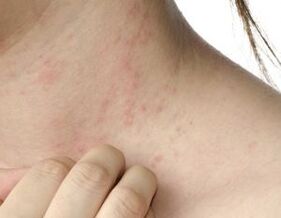
The symptoms of this dermatosis are recognizable even to those who have never encountered a similar problem.A common sign of the presence of lichen planus is a varied rash on the skin.
This rash appears in areas of inflammation of the epidermis, can be large or pinpointed, with peeling, and sometimes purulent filling.Each individual element of such a rash is called papules.Observations of patients with psoriasis have shown that this disease can show the first signs even before papules appear on the body.
In most cases, the appearance of a rash is preceded by a change in mood, loss of appetite, and digestive disorders.It has been noticed that a depressed state, often without reason, very often appears a few days before the formation of the first papules.The problem is that patients with such symptoms do not see a reason to see a doctor.But even if you visit a doctor in a timely manner, a specialist cannot always determine the true cause of this condition and make a correct diagnosis.
The appearance of a rash on the body is the main symptom of psoriasis.Depending on the type of scaly lichen (and there are dozens of them), the location of the lesion, and the age of the patient, the disease can manifest itself in different ways.
Manifestations in children
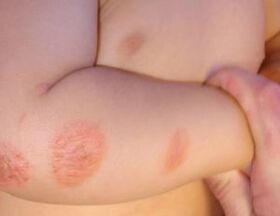
Lichen squamosus can occur even in infants.This is very rare, but is often aggravated by the parents themselves.The first signs of the disease may resemble heat rash or allergies, so adults rely on their own knowledge and treat the child themselves.In most cases, babies with psoriasis come to the doctor at an advanced stage of the disease.
In infants, scaly lichen most often appears in folds: on the inner thigh, armpits, between the toes and hands, in the folds of skin on the neck.The appearance of papules is often accompanied by itching, so the baby may be very restless, not sleep at night, and refuse to eat.
The affected areas resemble infant thrush, common diaper rash or eczema.Inflamed skin becomes red or pink and feels hot to the touch.Pustules can appear pointwise or form entire spots - plaques.As a rule, such spots rise above healthy skin.A distinctive feature of psoriatic plaques is the presence of a dry crust and scales on the rash, but in an infant, papules and plaques are often located in areas of profuse sweating, which is why the surface of the inflammation is moist.
When such symptoms appear, it is important not to waste time on folk remedies and tips from the older generation.If a newborn has a rash (of any nature), he urgently needs to be shown to a pediatrician and dermatologist.Treatment of psoriasis in infants is not much different from adult therapy; the baby is prescribed medicinal non-hormonal ointments, and in severe cases, tablets and injections.
In older children, the initial symptoms of lichen planus are no different from adults.However, children can suffer from any type of psoriasis:
- Plaque-like- occurs most often.Its signs are dry, red, hot spots.Papules are covered with a hard crust with pale scales on the surface.They can appear anywhere, pointwise or consolidate into plaques.Most often it itches, but not necessarily.
- Pustular– characterized by the presence of fluid or pus inside the papules.The initial stage is the same as that of the plaque-like one: papules with clear edges, rising above the epidermis, but filled with fluid.
- Scalp- may look like dandruff, but over time it forms a very flaky crust on the entire surface of the head or part of it.The hair in the affected areas thins and becomes thin.Often this type of psoriasis appears in the folds behind the ears.
- Palmoplantar– almost never occurs in children.It differs in localization on the palms and soles, with “lakes” of rough skin and scales appearing.
- Flexion surfaces– forms most often on the elbows, knees, and genitals.It differs from other types of psoriasis in the absence of scales.The affected skin becomes covered with a smooth and hard crust, resembling a single spot raised above the surface of the healthy epidermis.Color – pale pink, gray-white, pink.
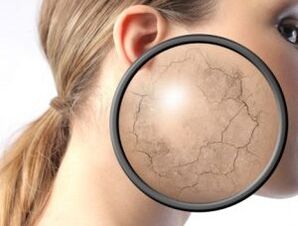
For any manifestations of local peeling and inflammation on the skin, you should consult a dermatologist.Childhood psoriasis progresses very quickly, especially if it is accompanied by itching.
Damaged papules easily become infected, grow and cover an increasingly larger area.After the prescribed treatment regimen, it is important to constantly monitor the child, prevent scratching of wounds and new injuries on the body, and follow a diet.
Manifestations in women
The first stage of psoriasis can appear at any age, but most often the first outbreaks occur before the age of 20, although the disease can “sleep” until the age of 50.Adult men and women experience the same symptoms as teenagers.At an older age, the risk of developing psoriasis on the soles, nails, and joints increases.
World disease statistics have revealed that women suffer from lichen planus almost one and a half times more often, while the majority struggle with plaque psoriasis.What exactly causes this selectivity is not known exactly, but scientists suggest a hormonal factor among the causes of psoriasis.
Due to the same hormones, signs of scaly lichen in girls most often appear during PMS, when hormonal levels change.Also, a woman’s natural sensitivity makes her more vulnerable to stress, depression, and neuroses.For a person with a predisposition to psoriasis, any psychological instability can provoke an outbreak of the disease.
Other causes of exacerbation of the disease include:
- skin damage (burns, cuts, open wounds);
- allergic reactions;
- infectious diseases;
- metabolic disorder;
- bad habits and unhealthy diet.
Essentially, if a woman has a genetic predisposition to psoriasis, one of the irritants will sooner or later trigger an outbreak.To avoid such exacerbations in the future, the patient must carefully monitor his lifestyle.
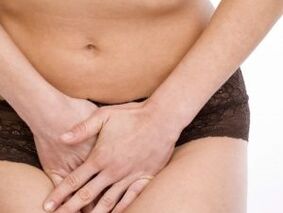
The symptoms of psoriasis in women are the same as in men, the only gender difference appears when the external genitalia are affected.In the genital area, girls are faced with a plaque-like and inverse appearance, sometimes pustular.The first symptoms are inflammation of the skin on the labia or pubis; the mucous membrane is rarely affected.
Small pinhead-sized papules may appear in several pieces or as a single spot.Scales rarely appear in genital psoriasis, since the location does not allow air to enter.A distinctive feature of a psoriatic rash is that the papules and plaques protrude slightly above the surface and are hot.If you have such symptoms, you should immediately contact a dermatologist and gynecologist.
Manifestations in men
The male half, as we have already noted, suffers from scaly lichen a little less often than women.However, the course of the disease and symptoms remain the same for both halves.A survey and analysis of patients revealed that in men the first symptoms appear between the ages of 22 and 25, while in women this occurs from the age of 15.Such “delayed” symptoms are associated with the fact that in the stronger half, hormonal balance occurs later.
Psoriasis begins in men in the same way.In most cases, small papules with silvery scales appear first, then they combine into larger spots - plaques and “paraffin lakes”.
Guttate psoriasis affects large areas of the body at once, but in separate small compounds.
You can distinguish psoriasis from other skin diseases at home if you carefully examine the inflamed elements:
- A dense, rough crust forms on the surface of the papules and plaques, which peels off.White scales on the surface come off easily when scraped, resembling shavings.
- If you completely clear the papule of scales, a thin transparent film remains on it.
- When removing the film from the psoriatic element, large drops of blood appear in this place, since there are many capillaries located in the papules.
In addition to obvious symptoms, scaly lichen is sometimes accompanied by a general weakening of the body, a depressed state, and an increase in body temperature.Psoriatic elements can be different in shape, for example, small individual papules appear in small quantities with a targeted lesion.Infection of a large area of the body at once (the entire back, sides, abdomen, legs) occurs with guttate psoriasis, and the papules are shaped like drops.Large, localized patches are a sign of coin psoriasis.
Based on observations of patients of both sexes, scientists concluded that in men, lichen planus is more severe, and the frequency of exacerbations is greater than in women.Reviews from specialists noted that this is due to a banal reluctance to be treated.The weaker half is still more attentive to their health and visits the doctor for preventive purposes much more often than the stronger sex.The only type of psoriasis for which men do not hesitate to treat is genital psoriasis.Plaque-like, inverse, or pustular plaques may appear on the glans penis, scrotum, or pubis.
Given the sensitivity of the skin in these areas, inflammation progresses very quickly and requires immediate treatment.When identifying any rash on the genitals, you should not waste time on “self-examination” and self-medication.Even excessive peeling of the skin, without red inflammation and itching, is considered a reason to consult a doctor.
Psoriasis of the nails (onychodystrophy) and scalp in men is also common.It is these two types, according to dermatologists, that men most often trigger.Despite the fact that there are a lot of photos on the Internet with signs of the disease, the symptoms of scaly lichen are perceived as fungus or dandruff, and people go to the doctor with an already progressive form.
When the scalp is affected, severe peeling appears, sometimes itching, and a rough crust in places or over the entire surface of the scalp.Nail psoriasis is manifested by a change in the color of the nail, the appearance of depressions and tubercles, and hardening of the nail plate and the skin around it.We will look at the gradation of symptoms in more detail below.
So, in children, women and men, the symptoms of psoriasis are no different.The reason for visiting a doctor is any inflammation on the skin of the body, head or nails.If the affected areas do not itch or peel, this does not mean that the skin is not affected by psoriasis.
Symptoms of psoriasis
The first signs of the disease usually last for several days, after which they begin to progress rapidly.Sometimes the disease can develop very slowly and the initial symptoms “linger” for a week or more.In any case, the disease will enter a full-fledged phase, sooner or later.The location of psoriasis often misleads both patients and specialists themselves.The same nail psoriasis at the first manifestations is very difficult to distinguish from a common fungal infection.
Manifestations on the scalp
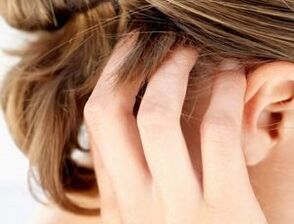
In the first stages of development, psoriasis on the scalp looks like slight flaking.Gradually, the affected areas acquire a reddish tint, may hurt and itch, and sometimes protrude beyond the hairline: on the back of the head, behind the ears, on the forehead.The epidermis in inflamed areas becomes denser; the dense structure of a psoriatic rash is considered one of the distinctive features.
This manifestation is often confused with seborrhea, in which the scalp is also very flaky.However, unlike seborrhea, psoriatic elements bleed if the top scaly layer is removed from them.In addition, psoriasis is characterized by roughening of the affected skin.If such a rash is accompanied by severe itching, patients often aggravate the situation by injuring plaques and papules.Open wounds quickly become infected and the disease progresses.
This type of scaly lichen appears in children and adults.Attempts at self-medication often only worsen the picture of the disease, so at the first suspicion of psoriasis it is better to consult a specialist.A trichologist and a dermatologist can accurately understand the nature of the inflammation; it is better to first show the child to a leading therapist.
Manifestations on the skin of the body
On the body, most often the first papules appear in places of bends and friction: on the knees, in the armpits, on the elbows, on the neck.Depending on the type of psoriasis, symptoms may vary.Like children, adults may experience many types of this disease, but there are a few more items to add to the list above.
In addition to the most common types of lichen planus, people over the age of 18 may experience:
- Pustular,which is no different in symptoms in adults and children.It affects any part of the body and has a severe course.Often accompanied by fever and general weakness.Papules first fill with clear fluid, which distinguishes this type of disease from others.If they become damaged and become infected again, pus appears in them.
- Erythrodermic psoriasis.It is considered a very complex form of this disease; most often it does not appear immediately, but progresses from plaque-like or pustular.But independent flow is also possible.Unlike regular psoriasis, this one affects large areas of the body and develops very quickly.Papules can be “empty” or filled with pus.If psoriatic elements hurt and grow at a high speed, affecting large areas of the body, it is most likely erythroderma.
- teardrop-shaped,which, as we have already found out, is characterized by pinpoint and frequent skin lesions.At the beginning of the disease, the papules are very small, with clearly defined edges, and have a convex teardrop shape.At the first signs it affects small areas of the body, but gradually grows.May appear on the arms, legs, stomach, back, neck.
- Arthritic psoriasis.The worst thing that can happen with this disease is damage to the joints.Most often, this occurs in people who already suffer from one of the types of psoriasis, but it can also appear as an independent disease.It first affects small joints: the phalanges of the toes and hands, and often spreads to more important locations.The first signs for it are pain and aches in the joints, fever, and swelling of the phalanges of the fingers.
Arthric and erythrodermic psoriasis are considered especially dangerous, as they entail more serious complications.If the joints are affected, the disease can lead to real disability.However, most often the most severe forms of the disease appear in those patients who already have psoriasis.
Manifestations on the legs
The legs are most often affected in the knee area and may be inverse or plaque psoriasis.In this case, the knee is completely or partially covered with a dense crust with a rough white surface.Most often, when the knees are affected, the same thing happens on the elbows, but not necessarily.We have already learned how to identify psoriasis by papules.
Also, the legs are a common affected area for the teardrop type.In this case, most of the leg is covered with small papules, which occupy the area from the lower leg to the thigh.The elements are inflamed, hot, sometimes itchy and painful.
Coarsening of the skin, painful itchy calluses on the feet indicate plantar psoriasis, and it can also “affect” the palms of the hands.This is a very common form of the disease, since the feet are most susceptible to mechanical stress.The skin at the site of the lesion cracks, peels, and itches.It is important to seek advice in time, as fungi and infections can get into the cracks, causing severe complications.
Manifestations on nails
Onychodystrophy affects the nail plate.It often accompanies other, more complex forms of psoriasis, but sometimes appears independently.Patients also usually present with this disease very late, mistaking this disease for a fungus.Symptoms of the disease are:
- changing the shape of the nail;
- depressions and tubercles on the nail plate;
- change in nail color (light brown, cloudy, with dark spots);
- roughening of the skin under and around the nail;
- skin growth on the nail;
- peeling of the nail both along and across the plate.
It’s also not worth taking time to treat this type of disease.It progresses slowly but steadily, and eventually the patient may completely lose the nail without further recovery.In this case, you should also contact a dermatologist for advice.
Manifestations on hands
Psoriasis affects the arm area as often as the rest of the body.Most often it targets the elbow, since it is most subject to friction, bending, and damage.Inverse, plaque-like, pustular psoriasis is localized in this area.In this case, the first signs of the disease develop in the same way as on the knees.
A very problematic area on the hands is located in the armpits.Any type of disease progresses very quickly here, since it is a warm and humid place without good access to air.In this case, psoriasis is not always covered with a flaky crust; plaques and pustules may resemble normal irritation or diaper rash.
If the inflamed spots grow and multiply, you need to urgently consult a dermatologist.
Manifestations of the disease in joint damage
As already noted, the small joints in the fingers and toes are most often affected by psoriatic arthritis.In a complex course, this disease affects the spine and pelvic joints.It is very difficult to recognize the disease in the early stages, especially at home.Unfortunately, diagnosis is very complicated.Today, even clinics can only determine the consequences of joint damage, and not prevent the disease.
In most cases, arthropathic psoriasis is a complication of another form of this disease and very rarely acts as an independent disease.A distinctive feature is that it affects the connective tissue around the joint.For example, if the joints of the fingers are affected, the patient experiences dactylitis - inflammation of all tissues in the fingers.At the same time, they increase in volume, do not bend, and are very painful.
In conclusion
Today there is no single system for treating psoriasis, as well as a single medicine that would help every patient with this disease equally effectively.Scaly lichen is classified as a systematic non-contagious disease that occurs in a chronic form.It cannot be cured once and for all, but it is quite possible to achieve long-term remission.Detecting the disease in its early stages greatly simplifies this task.
For prevention purposes, doctors recommend undergoing a general examination and tests every six months to a year, even if there is no suspicion of any disease.If a rash, prolonged irritation, or large areas of peeling on the skin appear, you should immediately contact a specialist and not waste precious time on dangerous self-medication.